

If you’ve ever tried to price out a video production crew, you know the answers you get range from vague to wildly different. One vendor quotes $1,500. Another comes back at $12,000. Both are technically right — because video production crew cost depends on a handful of variables that most guides never bother explaining. This one will. By the end, you’ll know exactly what you’re paying for, what’s negotiable, and how to build a budget that doesn’t blow up on shoot day.
Why Video Production Crew Costs Vary So Much
The short answer: crew is not a commodity. A DP who has shot Fortune 500 campaigns for 15 years commands a different rate than someone three years in. A two-camera corporate shoot in a controlled studio environment requires a different crew size than a three-day documentary across multiple locations. Add in union versus non-union, city versus rural, and whether you’re renting gear or the crew is kit-equipped — and you have a genuinely wide range.
That range isn’t a problem if you understand what’s driving it. The goal of this guide is to give you the map, so you’re never walking into a quote blind.
For a full overview of crew roles and how they work together, see our guide on how to hire a video production crew.
Individual Crew Role Day Rates (2026)
These are current market rates for experienced non-union freelancers in mid-to-major U.S. markets. Rates in New York, LA, and Chicago tend to run 15–25% higher. Rural markets can be 20–30% lower.
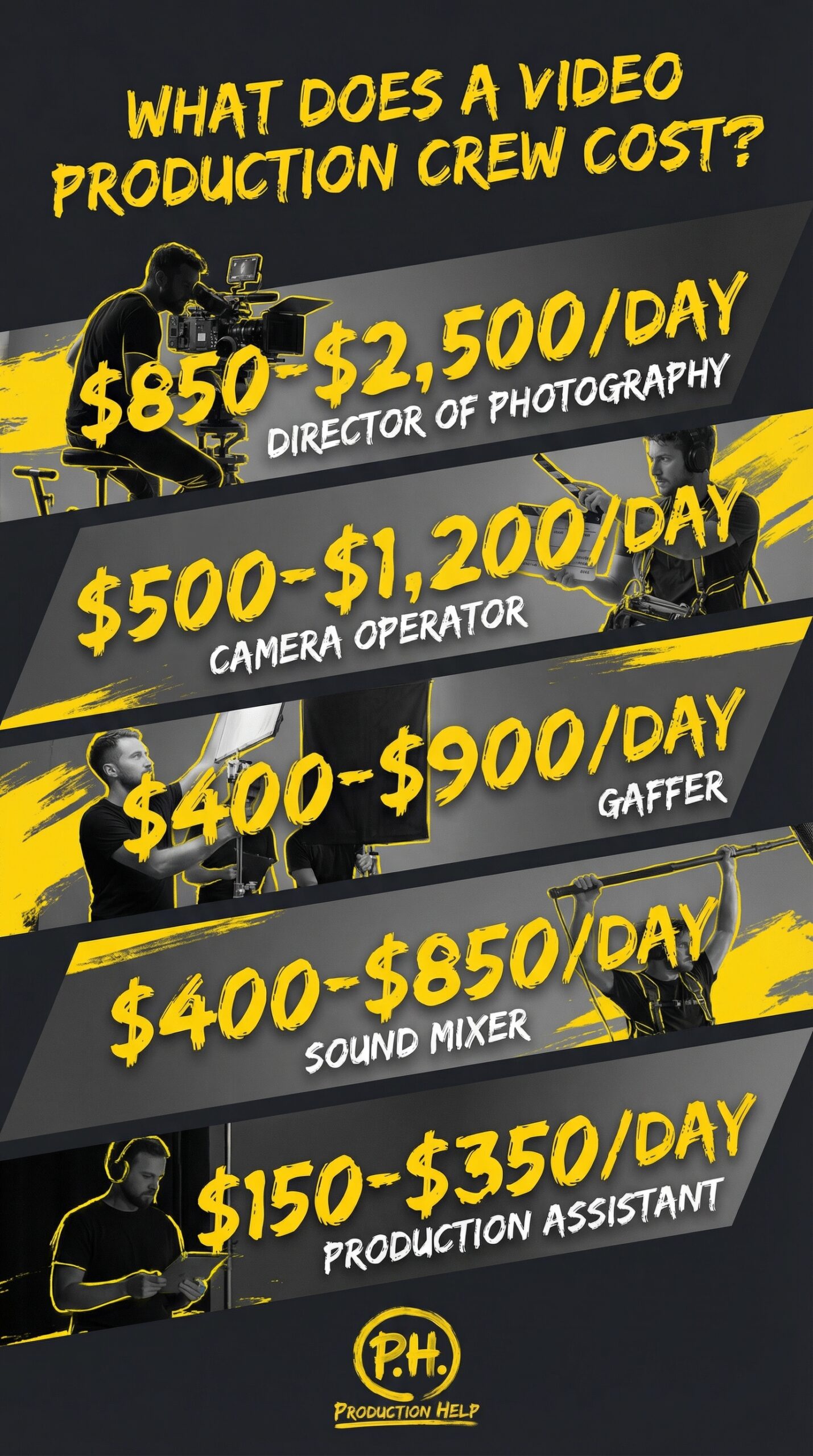
- Director of Photography (DP / Cinematographer): $850–$2,500/day — The single most variable rate on any crew. Entry-level DPs with a solid reel start around $850. Mid-tier working DPs with consistent commercial credits land at $1,200–$1,800. Top-tier DPs with broadcast or national brand credits: $2,000–$2,500+.
- Camera Operator: $500–$1,200/day — On single-camera shoots, the DP often operates. When you need a separate op (multi-cam, live events, documentary), budget $500–$800 for competent operators, $900–$1,200 for specialists (Steadicam, gimbal, drone).
- Gaffer (Chief Lighting Technician): $400–$900/day — Responsible for all lighting execution. Rate depends heavily on how complex your lighting package is and whether they’re supplying grip/electric gear.
- Key Grip: $350–$750/day — Works alongside the gaffer on rigging, camera support, and grip equipment. On smaller shoots, gaffer and key grip roles often combine into one.
- Sound Mixer / Production Sound: $400–$850/day — Location sound is one of the most under-budgeted line items. A skilled mixer with a proper kit (boom, lavs, cart) runs $500–$850. Don’t cheap out here — bad audio kills good footage.
- Production Assistant (PA): $150–$350/day — The crew backbone. Good PAs keep a shoot moving. Budget $200–$250/day for reliable, experienced PAs.
- Producer / Production Coordinator: $400–$1,000/day — If you’re not self-producing, a field producer or coordinator handles logistics, talent, and day-of execution.
According to BLS data, median annual wages for camera operators continue to climb — day rates reflect that trend.
Full Crew Package Rates
For most corporate and commercial productions, you’re not hiring individual roles — you’re booking a crew package. Here’s what typical full-day packages run in 2026:
- Minimal Crew (DP + 1 PA): $1,200–$2,500/day — Good for talking head interviews, simple product shots, or social content. One skilled DP handles camera and basic lighting.
- Standard Corporate Crew (DP + Camera Op + Sound + PA): $2,500–$4,500/day — The workhorse configuration for corporate videos, event coverage, and internal communications content.
- Full Production Crew (DP + Op + Gaffer + Grip + Sound + PA): $4,500–$8,000+/day — What you need for commercials, branded content, multi-location shoots, or anything requiring full lighting control and multiple camera angles.
- Large Commercial / Broadcast Crew: $8,000–$20,000+/day — Multiple departments, department heads, talent wrangling, art direction. Reserved for national spots and high-end branded content.
Use our crew directory to find vetted crews in your city, or contact us directly for a custom crew recommendation.
Factors That Move the Number Up or Down
Understanding the variables lets you control costs without sacrificing quality. Here’s what actually affects your final number:
Project Type
Corporate internal video = lower complexity, lower crew cost. National TV commercial = full departments, union consideration, higher rates across the board. Be honest about what you’re making — over-crewing a simple shoot wastes money, under-crewing a complex one costs even more on the day.
Location
Shooting in New York, LA, or Chicago? Add 20% to your estimate. Need crew to travel? Add travel days (full day rate or half-day rate, depending on distance), per diems ($75–$150/person/day), and hotel. Remote locations with no local crew pool mean you’re paying for travel no matter what.
Shoot Days vs. Prep Days
Most crew rate discussions focus on shoot days — but complex productions also bill for prep days (scouting, equipment prep, pre-light) at the same day rate or a negotiated flat fee. Build these into your budget from the start.
Union vs. Non-Union
IATSE and SAG-AFTRA projects come with minimum rates, pension/health contributions, and strict overtime rules. Non-union productions have more flexibility but still need to budget properly for turnaround time and overtime. Most corporate and branded content runs non-union.
Overtime
Standard shooting day is 10 hours (called a “ten-out-of-twelve” in the industry — 10 hours worked within a 12-hour window). Hour 11 starts overtime — typically 1.5x the hourly rate. Hour 14+ is often 2x. A shoot that runs long can add 20–40% to your labor cost in a single day. Build in schedule buffer.
How to Build a Video Production Budget That Actually Works
Start with your deliverable, work backward to your crew, and build in contingency from the start. Here’s the framework:
- Define the deliverable first. A 2-minute brand film has different production requirements than a 30-second social spot or a full-day corporate event capture. Don’t talk crew until you know the output.
- Estimate shoot days honestly. First-time producers almost always underestimate. If you think it’s a one-day shoot, build in a half-day contingency. If it’s two days, budget for two and a half.
- Price crew before gear. Crew is your biggest line item. Nail that number first, then layer in equipment rental (typically 15–25% of total production budget).
- Add 10–15% contingency. Non-negotiable. Things go over. Weather, talent, locations, equipment failure — something always costs more than planned.
- Get itemized quotes. Demand a line-by-line breakdown from any production company or crew coordinator. “Day rate” quotes with no detail are a flag.
For deeper budgeting frameworks, explore our Budgets & Rates resource library and our production planning guides.
Questions to Ask Before You Book a Crew
These questions separate experienced hirers from first-timers. Ask all of them before you sign anything:
- Is equipment (camera, lenses, lighting) included in the day rate, or quoted separately?
- What’s the overtime policy and at what hour does it kick in?
- Are travel days billed at full rate, half rate, or a flat travel fee?
- Does the crew carry their own liability insurance? Can you be added as additionally insured?
- What’s the cancellation / postponement policy, and what deposit is required?
- Have they worked on projects similar to yours? Can they share a relevant reel?
Browse crew profiles with verifiable credits on our production crew directory. You can also find Mandy.com useful for vetting freelancer history.
Frequently Asked Questions
What is a typical day rate for a video production crew in 2026?
A standard corporate crew (DP, camera op, sound, PA) runs $2,500–$4,500 per day in most U.S. markets. Full production crews with lighting and grip departments start at $4,500 and can reach $8,000+ for complex commercial shoots.
Is it cheaper to hire a production company or book crew directly?
Booking crew directly is typically 20–35% less expensive than going through a full-service production company — but you’re also taking on all the coordination, logistics, and creative direction yourself. For first-time hirers or high-stakes productions, a production company’s markup often pays for itself in execution quality and problem-solving.
Do I need to pay for equipment on top of crew rates?
Often yes. Many DPs and gaffers charge a “kit fee” (typically $100–$400/day) for providing their own camera package or lighting gear. Always clarify upfront what’s included in the day rate and what’s additional. For a full breakdown of crew hiring considerations, see our category guide.
What is the minimum crew I need for a professional corporate video?
For most corporate talking-head or office-environment shoots, a two-person crew (experienced DP + PA) is the minimum that delivers professional results. Add a dedicated sound mixer the moment dialogue quality matters — which is almost always.
Ready to Find the Right Crew for Your Budget?
Now you have the numbers. A basic corporate shoot might run you $2,500–$4,000 for a solid day’s work. A multi-day commercial production with full departments could reach $15,000–$30,000 in crew costs alone. Neither number is wrong — it’s about knowing what you need, building the right team, and not leaving surprises for shoot day.
ProductionHelp.io exists to make that process faster and less stressful. Whether you’re pulling together your first crew or optimizing a budget you’ve run a hundred times, we’ve got the resources and the roster to help. Talk to us and we’ll point you in the right direction.