
Introduction: Why Hiring the Wrong Video Production Crew Is Costly
Hiring a video production crew for your next shoot can make or break your project. The wrong team leads to wasted budgets, missed deadlines, and footage you can’t use. Whether you’re planning a corporate video, a commercial shoot, or a documentary, knowing exactly how to hire a video production crew — and what to look for — is the most important decision you’ll make before cameras roll.
In this guide we break down every role, rate structure, and red flag so you walk into your next production fully prepared.
What Does a Video Production Crew Actually Include?
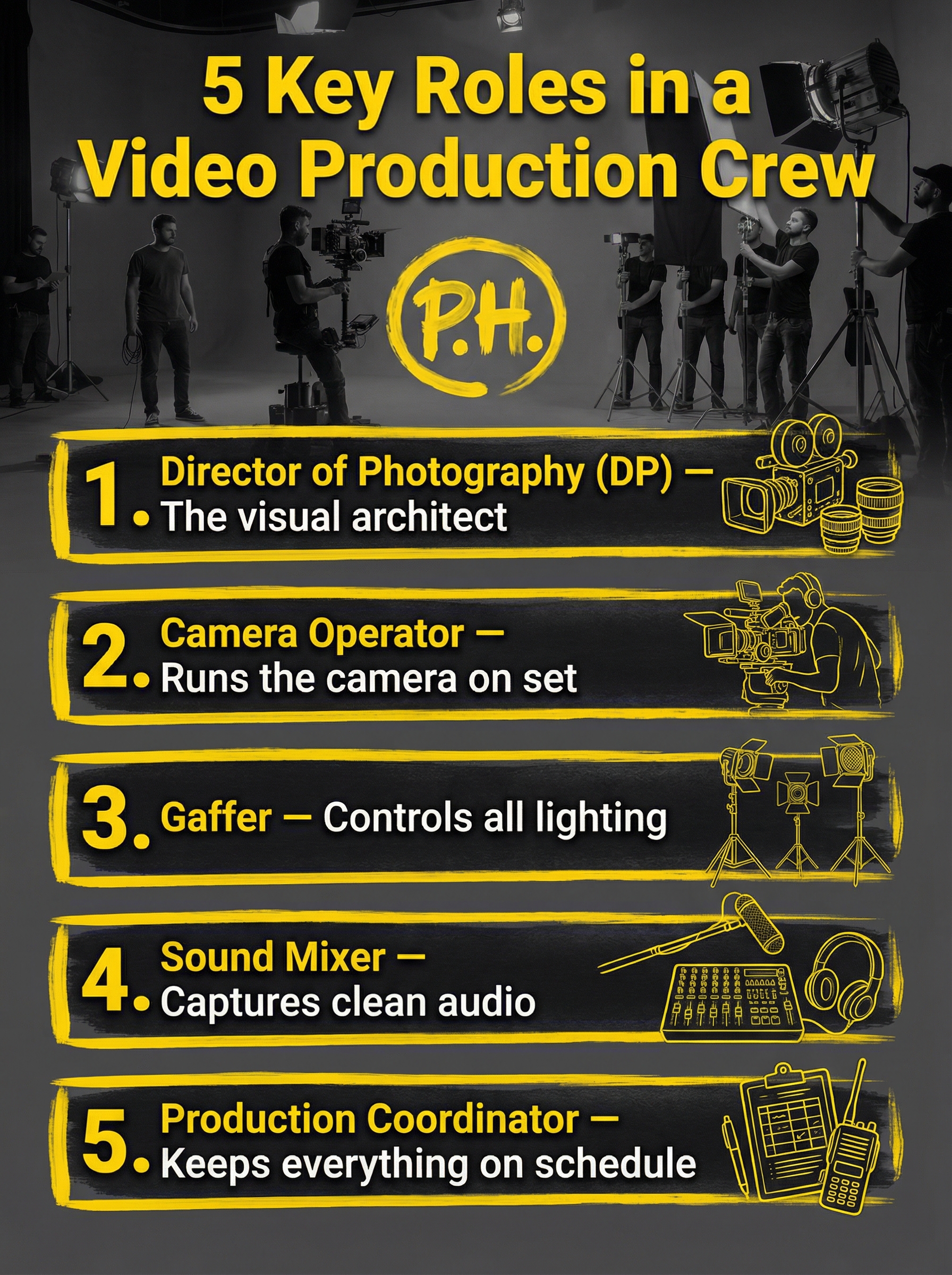
When you set out to hire a video production crew, understanding the core roles is step one. Here’s who you’ll encounter on most professional shoots:
- Director of Photography (DP): The visual architect. Responsible for camera placement, framing, and the overall look of the video.
- Camera Operator: Operates the camera under the DP’s direction. Larger shoots may have multiple operators.
- Gaffer: Head of the electrical department — controls all lighting design and power on set.
- Sound Mixer: Captures clean, broadcast-quality audio in real time.
- Production Coordinator: The logistics backbone — handles scheduling, permits, vendor coordination, and crew communication.
- Production Assistant (PA): Generalist support for the whole crew. Essential for fast-moving shoots.
Not every project needs all of these roles. The right mix depends entirely on your shoot type and budget — which we cover next.
How to Determine What Crew You Actually Need
Crew size and composition should match your project type. Over-hiring burns budget; under-hiring kills quality. Here’s a quick breakdown:
- Corporate Video: Lean crew — DP, sound mixer, and 1–2 PAs. Fast-moving and efficient.
- Event Coverage: Multiple camera operators for multicam, plus dedicated audio. Coordination is key.
- Commercial / Brand Film: Larger crew with a dedicated gaffer, grip team, and art department.
- Documentary: Often a small, agile crew — DP doubling as camera operator, a sound recordist, and a producer.
If you’re unsure what your project needs, browse our crew directory to see how experienced professionals list their specialties and project types.
Where to Find Qualified Video Production Crew Members
The best crews come from three sources:
- Crew Directories: Platforms like ProductionHelp.io list verified freelance crew members by role, location, and gear. Search by market, filter by specialty, and connect directly.
- Referrals: Your best hires often come through trusted colleagues. Ask your DP who they like to work with — crews often travel in networks.
- Production Companies: For larger projects, full-service production companies provide the entire crew under one contract. Simpler but typically higher cost.
For most corporate and commercial productions, a searchable crew directory gives you the fastest path to vetted, available talent in your market. Resources like StaffMeUp and Mandy.com also list crew by market, though vetting and verification varies by platform.
Key Questions to Ask Before You Hire a Video Production Crew
Before you sign any agreement, ask every crew member or vendor these questions:
- What are your day and project rates? — Understanding video crew rates upfront prevents budget surprises later.
- Can I see recent work similar to my project? — Portfolio review is non-negotiable.
- Do you own your gear or rent? — Owned gear often means faster setups; rented gear may offer more options.
- Are you available for potential reshoot dates? — Build this into the conversation early.
- Do you use a standard contract? — Any professional crew should. If they don’t, provide your own.
Day Rates vs. Project Rates Explained
This is one of the most misunderstood parts of hiring a video production crew. Here’s how to think about it:
- Day Rate: Charged per shooting day, typically 8–10 hours. Industry standard for most freelance crew. Rates vary by market and role — a DP in New York will charge more than in a secondary market.
- Project Rate: A flat fee for the entire engagement, regardless of days. Better for well-defined, multi-day projects where scope is locked.
- Half-Day Rate: Most crew members offer a half-day rate for shoots under 5 hours. Ask about it — it can save real money on interview or pickup shoots.
Industry benchmarks for video production day rates vary by region, but for most U.S. markets expect $600–$1,200/day for an experienced DP and $400–$800/day for a sound mixer. The U.S. Bureau of Labor Statistics tracks median wages for camera operators and related crew as a useful baseline when evaluating rate requests.
Red Flags to Watch For When Hiring Crew
The hiring process reveals a lot. Watch for these warning signs:
- No references or portfolio: Every working professional has both. No exceptions.
- Vague communication: If they’re slow or unclear before the job, it’ll be worse on set.
- Rates far below market: Suspiciously low rates usually mean hidden costs, inexperience, or gear problems mid-shoot.
- Resistance to a contract: A standard deal memo or crew agreement protects both parties. Anyone who pushes back on paperwork is a risk.
- No liability insurance: Professional crew members carry general liability and equipment insurance. Ask for a COI on larger jobs.
Ready to Hire Your Video Production Crew?
The right crew doesn’t just execute your vision — they elevate it. By understanding the roles, asking the right questions, and knowing the red flags, you’re already ahead of most buyers.
Search the ProductionHelp.io directory to find verified camera operators, DPs, gaffers, sound mixers, and production coordinators in your market — filterable by location, role, and specialty. Have a question? Get in touch with our team.