By the ProductionHelp.io Team | February 2026
In the fast-paced world of digital marketing and corporate communications, video content is no longer a luxury – it is the main event. As businesses and creative agencies scramble to meet the insatiable demand for high-quality video, a new challenge has emerged: how do you hire a local production crew that is reliable, professional, and budget-friendly? The success of your project hinges on the talent behind the camera, and in 2026, the gig economy has transformed how this talent is sourced, vetted, and booked.
This comprehensive guide will walk you through the entire process of hiring a local production crew. We will cover the booming demand for video, break down the essential crew roles, provide up-to-date day rates for 2026, and show you exactly where to find the top-tier talent that will bring your vision to life. Whether you are a seasoned producer or a marketing manager stepping onto a set for the first time, this guide is your roadmap to building a dream team for your next project.
The Unstoppable Rise of Video Content (And Why It Matters for Hiring)
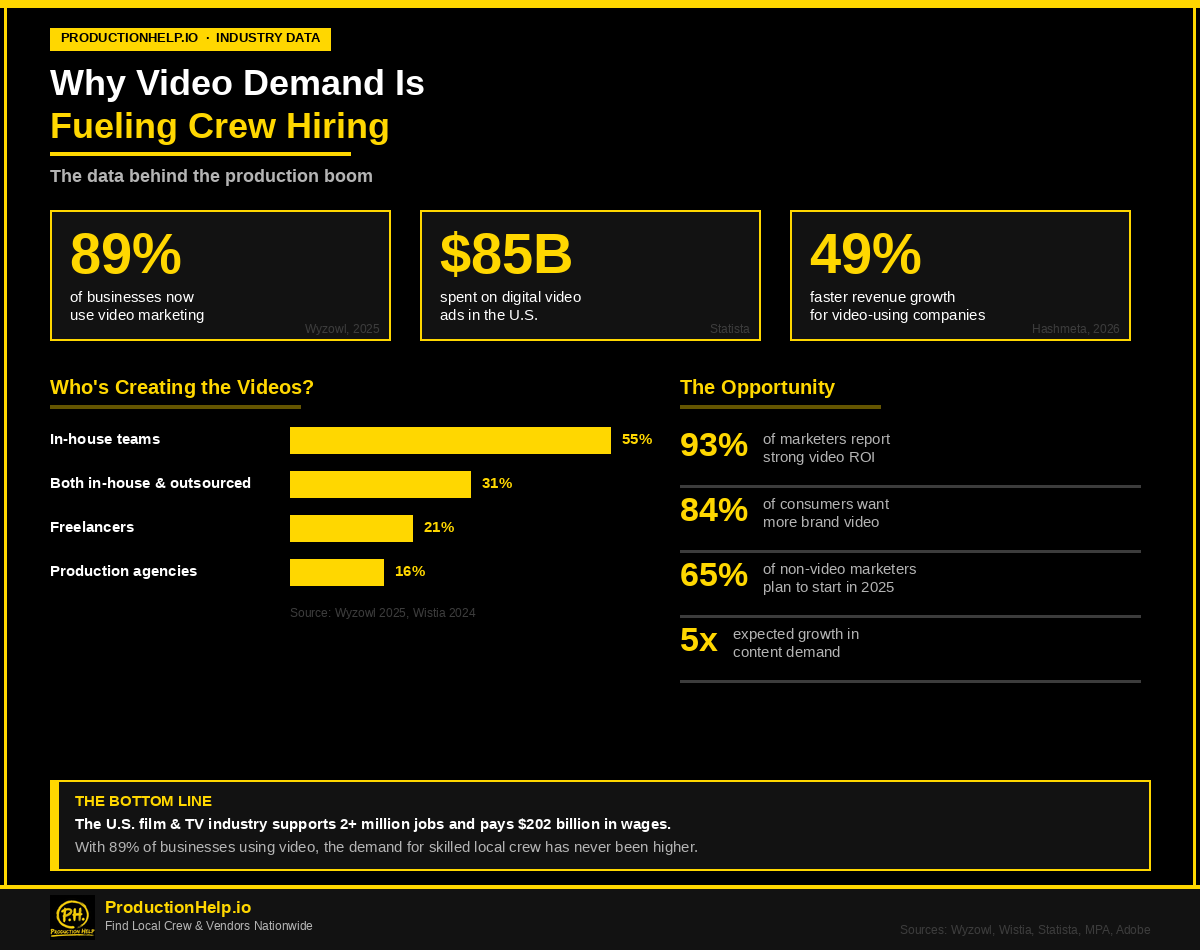
The demand for video is not just growing – it is exploding. According to the Wyzowl Video Marketing Statistics 2025 report, 89% of businesses are now using video as a marketing tool, and a staggering 93% of marketers consider it a crucial part of their overall strategy, a finding echoed by Wistia’s 2024 State of Video Report. This surge is fueled by incredible returns on investment, with 93% of marketers reporting a strong ROI from their video marketing efforts.
This is not a passing trend; it is a fundamental shift in how brands communicate with their audiences. Research from Hashmeta shows that companies using video marketing grow their revenue 49% faster year-over-year than organizations without video strategies. The financial commitment to video is massive: U.S. businesses now spend more on digital video ads ($85 billion) than on traditional TV ads ($59 billion), according to Statista. The Interactive Advertising Bureau (IAB) reported that video ad spend grew 18% year-over-year in 2024, reaching $64 billion and projected to hit $72 billion in 2025.
What does all of this mean for production crew hiring? It means the demand for skilled, local professionals, including camera operators, gaffers, sound mixers, and more, has never been higher. And it is only accelerating. Adobe’s research indicates that content demand is expected to grow 5x in the coming years, with 66% of marketers saying that social content demand is growing the fastest. Meanwhile, 65% of marketers who are not yet using video plan to start in 2025. Every one of those new video projects needs a crew.
The U.S. film and television industry supports over 2 million jobs, pays out $202 billion in total wages, and comprises over 162,000 businesses, 93% of which employ fewer than 10 people. – Motion Picture Association
The industry is not just concentrated in Hollywood. According to the MPA, the industry pays out $20 billion per year to more than 210,000 businesses in cities and small towns across the United States. As much as $1.3 million can be injected into local economies per day when a film shoots on location. This decentralized nature of production is exactly why finding local crew is so important, and so valuable.
Assembling Your Production Dream Team: Key Roles Explained
Building a production crew is like assembling a team of specialists, each with a unique and critical function. Understanding these roles is the first step to ensuring your production runs smoothly and your final product is polished and professional. While a small corporate interview might only require a camera operator and a sound mixer, larger projects demand a more extensive team with clear departmental structure.
The Bureau of Labor Statistics reports that there are approximately 79,900 jobs for film and video editors and camera operators in the United States, with the median annual wage for camera operators at $68,810 and for film and video editors at $70,980 as of May 2024. Employment in these roles is projected to grow 3% from 2024 to 2034, with about 6,400 openings projected each year. For producers and directors, the BLS projects 5% growth through 2034, with a median annual wage of $83,480.
Here is a breakdown of the essential on-set roles you will encounter on most productions:
| Role | Department | Description |
|---|---|---|
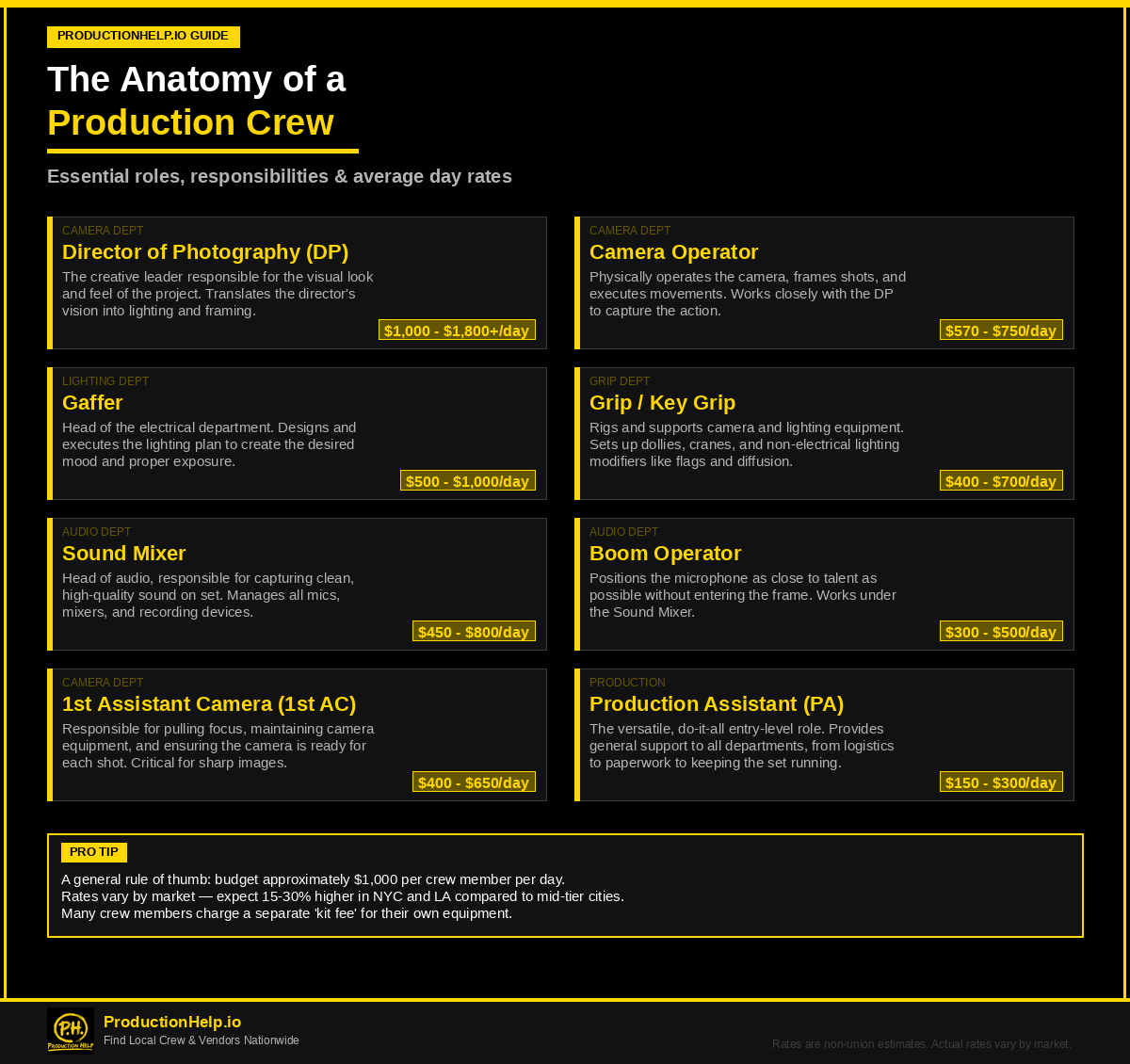
| Director of Photography (DP) | Camera | The creative leader of the camera and lighting departments. The DP is responsible for the visual look and feel of the project, translating the director’s vision into a tangible visual style through lighting, lens choice, and camera movement. |
| Camera Operator | Camera | The person physically operating the camera. They work closely with the DP to frame shots, execute camera movements, and capture the action. On smaller shoots, the DP may also serve as the camera operator. |
| 1st Assistant Camera (1st AC) | Camera | Primarily responsible for pulling focus, maintaining the camera equipment, and ensuring the camera is ready for each shot. A sharp 1st AC is critical for a sharp image. |
| Gaffer | Lighting | The head of the electrical department, responsible for designing and executing the lighting plan. They work with the DP to shape the light and create the desired mood and exposure for every scene. |
| Grip / Key Grip | Grip | The muscle of the set. Grips are responsible for rigging and supporting the camera and lighting equipment. This includes setting up dollies, cranes, and any non-electrical lighting modifiers such as flags, silks, and diffusion frames. |
| Sound Mixer | Audio | The head of the audio department, responsible for capturing clean, high-quality audio on set. They manage all microphones, mixers, and recording devices, and are the last line of defense for usable production sound. |
| Boom Operator | Audio | Works under the Sound Mixer to position the microphone (usually on a boom pole) as close to the talent as possible without it being seen in the shot. Requires physical endurance and a keen sense of framing. |
| Production Assistant (PA) | Production | The entry-level, do-it-all role on set. PAs provide general support to all departments, from getting coffee to managing paperwork, locking up locations, and helping to keep the set running efficiently. |
Understanding who does what is critical for two reasons. First, it helps you budget accurately by knowing which roles you actually need. A two-person corporate interview setup is very different from a 15-person commercial shoot. Second, it helps you communicate effectively with your crew, which builds trust and leads to a better final product.
The Cost of Creativity: 2026 Production Crew Day Rates
Budgeting is one of the most challenging aspects of any production. Rates can vary wildly based on geography, experience, union status, and the specific demands of the project. To help you plan effectively, we have compiled a table of average non-union and freelance day rates for key production crew roles in 2026. These figures are drawn from industry surveys and rate sheets as well as market analysis from production companies.
| Role | Average Non-Union Day Rate (10-Hour Day) |
|---|---|
| Director of Photography (DP) | $1,000 – $1,800+ |
| Camera Operator | $570 – $750 |
| 1st Assistant Camera (1st AC) | $400 – $650 |
| Gaffer | $500 – $1,000 |
| Grip / Key Grip | $400 – $700 |
| Sound Mixer | $450 – $800 |
| Boom Operator | $300 – $500 |
| Production Assistant (PA) | $150 – $300 |
A general rule of thumb: budget approximately $1,000 per crew member per day as a starting point. This is a useful benchmark for initial planning, though actual costs will depend on the specifics of your project and market.
It is important to remember that these rates often do not include equipment. Many freelance operators will offer a separate “kit fee” for their gear package, including camera body, lenses, lighting, and audio, which can range from a few hundred to several thousand dollars per day depending on the equipment. Always clarify whether a rate is “labor only” or “labor plus kit” when negotiating.
Geographic variation also plays a significant role. Expect to pay 15-30% more in major production hubs like New York City and Los Angeles compared to mid-tier markets like Atlanta, Nashville, or Austin. However, these mid-tier markets often offer exceptional talent at more competitive rates, which is one of the key advantages of hiring locally through a directory like ProductionHelp.io.
Union rates, governed by organizations like the International Alliance of Theatrical Stage Employees (IATSE), will generally be higher and are subject to collective bargaining agreements. For example, IATSE Local 600 camera operator rates can range from negotiated minimums up to $774 per day depending on the tier and project type.
Where to Find and Hire Local Production Crew Talent
Knowing the roles and rates is half the battle. Now, where do you actually find these skilled professionals? The landscape for hiring production crew has evolved significantly over the past decade, moving from word-of-mouth referrals and personal rolodexes to a more democratized, online marketplace. According to the Wistia 2024 State of Video Report, 62% of companies rely on individuals within the company to make videos, 46% use an in-house video producer or team, 21% hire freelancers, and 16% use a video production agency. That 21% freelancer figure represents a massive market of project-based hiring, and it is growing.
The Power of Production Directories
This is where a dedicated platform like ProductionHelp.io becomes an invaluable asset. Online directories are the modern-day rolodex for the production industry, offering a centralized, searchable database of crew and vendors organized by location and specialty. They are, without a doubt, the most efficient way to source local talent for any project.
Here is why directories are the go-to solution for producers and agencies:
Efficiency. Instead of cold-calling contacts, posting on scattered job boards, or scrolling through social media groups, you can filter by location, role, and specialty to find exactly who you need in minutes. Need a gaffer in Atlanta? A sound mixer in Chicago? A full camera crew in Dallas? A good directory gets you there fast.
One-Stop-Shop. Find everyone from your DP to your PA, and even locate local rental houses, studios, and other production vendors, all in one place. This consolidation saves enormous amounts of time during the pre-production crunch.
Other Avenues for Crewing Up
While directories are the most direct route, other resources can also be effective depending on your situation:
Social Media Groups. Facebook and LinkedIn have numerous industry-specific groups where crew calls are frequently posted. While useful for networking, they can be cluttered, unorganized, and require more effort to vet candidates. The signal-to-noise ratio can be challenging.
Film Commissions. State and city film commissions often maintain their own lists of local crew and vendors. This can be a great resource, especially if you are looking to take advantage of local film tax incentives. States like Georgia (20% base tax credit), New Mexico (25-35%), and Louisiana (25-40%) offer significant incentives that can offset production costs.
Word-of-Mouth. Referrals from trusted colleagues remain a powerful tool in the production industry, where reputation is everything. However, this method can limit your reach and may not be feasible when you need to crew up quickly in a new city or market.
Vetting and Hiring Your Local Production Crew: Best Practices
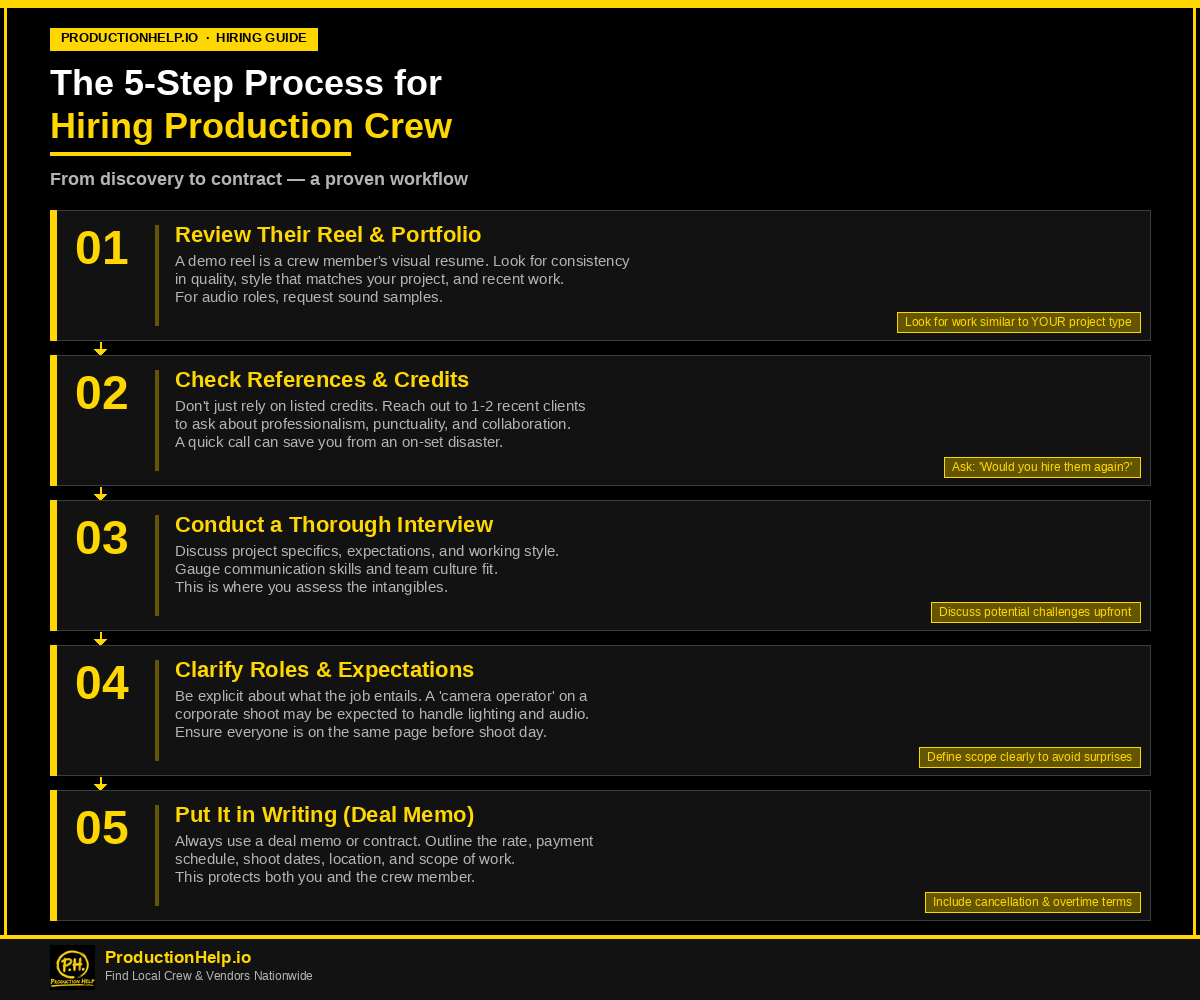
Finding a candidate is just the beginning. Proper vetting is crucial to avoid on-set disasters and ensure you are hiring a true professional who will elevate your project. The production environment is high-pressure, time-sensitive, and collaborative. A bad hire can derail an entire shoot day. Here are five essential steps for the hiring process:
Step 1: Review Their Reel and Portfolio
A portfolio or demo reel is a crew member’s visual resume. Does their visual style match your project? Is the quality of their work consistently high? For roles like sound mixers, ask for audio samples. Look for work that is similar to the type of project you are producing. A DP who specializes in documentary work may not be the best fit for a high-end commercial, and vice versa.
Step 2: Check References and Credits
Do not just rely on the listed credits on a resume or profile. Reach out to one or two recent clients to ask about their experience. Were they professional? Punctual? A good collaborator? Did they handle unexpected challenges well? A quick five-minute phone call can save you from a very expensive on-set disaster.
Step 3: Conduct a Thorough Interview
Discuss the project specifics, your expectations, and their working style. This is your chance to gauge their communication skills and ensure they are a good fit for your team culture. Production is inherently collaborative, and interpersonal dynamics matter as much as technical skill.
Step 4: Clarify Roles and Expectations
Be explicit about what the job entails. A “camera operator” on a corporate shoot might be expected to handle their own lighting and audio, which would typically be separate roles on a larger set. A “gaffer” might also need to serve as a grip. Make sure everyone is on the same page about the scope of work before the shoot day arrives.
Step 5: Put It in Writing
Always use a deal memo or contract. This document should outline the rate, payment schedule (net 15, net 30, etc.), shoot dates, location, and a clear scope of work. It should also address overtime rates, cancellation policies, and equipment responsibilities. This protects both you and the crew member and prevents misunderstandings down the line.
The Future Is Local and On-Demand
The demand for video content shows no signs of slowing down. With 87% of marketers planning to integrate video into their strategies and 84% of consumers wanting to see more video content from brands, the production industry is positioned for sustained growth. The Bureau of Labor Statistics projects steady employment growth for camera operators and editors as well as producers and directors through 2034.
As more companies embrace remote work and distributed teams, the ability to quickly and efficiently hire a local production crew anywhere in the country is no longer a competitive advantage – it is a necessity. A brand headquartered in New York may need a crew in Phoenix for a customer testimonial, then another crew in Miami for a product launch, and a third in Seattle for a corporate event, all in the same month. The old model of flying a single crew across the country is increasingly impractical and expensive.
The gig economy has empowered a new generation of freelance talent, and platforms like ProductionHelp.io are connecting them with producers and agencies in a more streamlined way than ever before. For crew members, being listed in a reputable directory means increased visibility and a steady pipeline of opportunities. For producers, it means access to vetted, local talent at the click of a button.
By understanding the key roles, budgeting effectively for day rates, and leveraging the power of online directories, you can demystify the hiring process and build a talented, reliable crew for any project, anywhere in the United States. The right team is out there, ready to help you create compelling video content that drives results. Now you know exactly how to find them.
Ready to find your next production crew? Browse local crew and vendors on ProductionHelp.io
Sources
Wyzowl. (2025). Video Marketing Statistics 2025. https://wyzowl.com/video-marketing-statistics/
Wistia. (2024). 2024 State of Video Report. https://wistia.com/learn/marketing/state-of-video
Hashmeta. (2026). Video Marketing Statistics: Essential Consumption Trends Shaping Digital Strategy. https://hashmeta.com/blog/video-marketing-statistics-essential-consumption-trends-shaping-digital-strategy/
Statista. (n.d.). Digital video advertising spending in the United States. https://www.statista.com/
Interactive Advertising Bureau. (2025). 2025 Digital Video Ad Spend & Strategy Full Report. https://www.iab.com/insights/video-ad-spend-report-2025/
Adobe. (2025). 71% of Marketers Say Content Demand to Increase 5x. https://business.adobe.com/blog/71-percent-of-marketers-say-content-demand-to-increase-5x
Motion Picture Association. (2024). Driving Local Economies. https://www.motionpictures.org/advocacy/driving-local-economies/
U.S. Bureau of Labor Statistics. (2025). Film and Video Editors and Camera Operators: Occupational Outlook Handbook. https://www.bls.gov/ooh/media-and-communication/film-and-video-editors-and-camera-operators.htm
U.S. Bureau of Labor Statistics. (2025). Producers and Directors: Occupational Outlook Handbook. https://www.bls.gov/ooh/entertainment-and-sports/producers-and-directors.htm
OnAssemble. (2024). Day Rates For Film Crew 2024: A Comprehensive Guide. https://www.onassemble.com/blog/a-comprehensive-guide-to-day-rates-for-film-crew-2021
Lunchbox Productions. (2025). Film Production Crew Rates in 2025. https://www.lunchboxproductions.co/post/blog
National Conference of State Legislatures. (n.d.). State Film and Television Incentive Programs. https://www.ncsl.org/fiscal/state-film-and-television-incentive-programs
Lemonlight. (2026). 67 Video Marketing Stats You Need to Know for 2026. https://www.lemonlight.com/blog/67-video-marketing-stats-you-need-to-know/