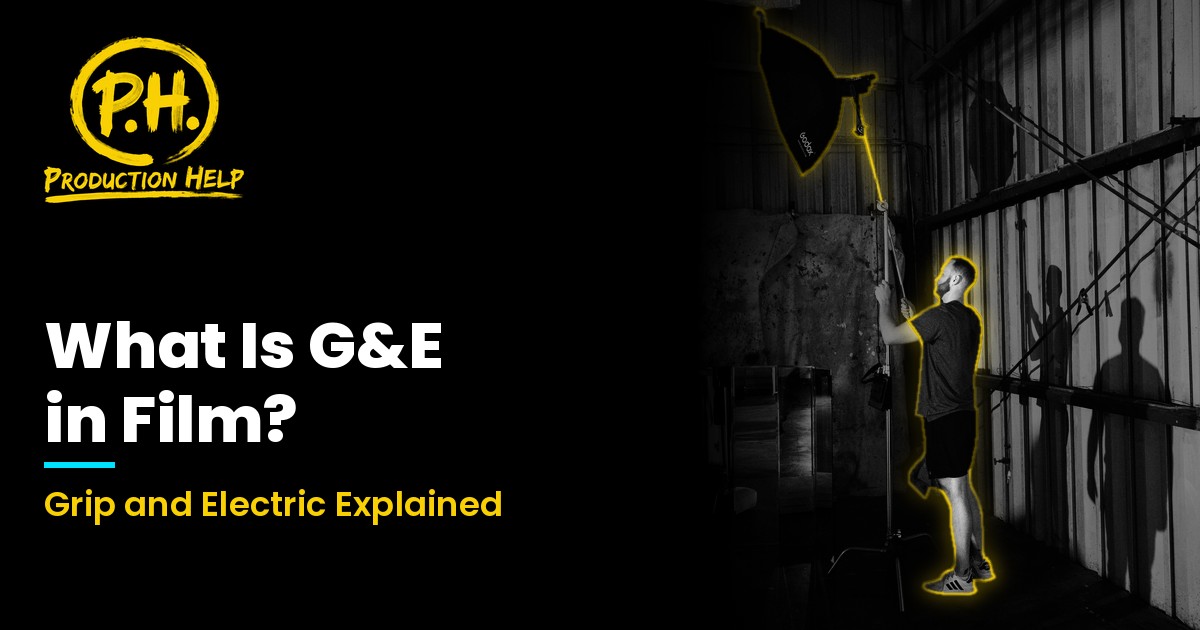
G&E in film stands for grip and electric. It is the shorthand for the two crews that light a set. The electric department, led by the gaffer, places the lights and runs the power. The grip department, led by the key grip, shapes that light with stands, flags and diffusion, and rigs and supports the camera. When a producer asks “who is our G&E?”, they mean those people, and often the truck of gear they bring.
Quick answer: G&E means grip and electric, the crew that lights your shoot and handles the power and rigging behind it. On a small interview, one G&E tech may cover both jobs. Bigger shoots book a gaffer, a key grip and their teams. On ProductionHelp you can find lighting and grip crews near you and post your job for free.

You will see G&E on call sheets, crew lists, job posts and rental house websites. If you are planning a shoot and someone asks whether you have G&E covered, this guide explains what they are asking, who is on that crew, what a “swing” is, and what to ask before you book.
What does G&E stand for in film?
G&E is short for grip and electric, two separate departments that work side by side. PremiumBeat's guide to the electric department explains that the electric department works alongside the grip department, under the director of photography (DP), to plan and carry out the lighting for each shot. Because the two crews work so closely, they are often referred to together as G&E.
Out loud, people say “G and E.” In writing it usually appears as G&E or grip/electric. It can mean the people, the departments, or the gear, depending on who is talking. A producer asking about G&E usually means crew. A rental house selling a G&E package means equipment.
The electric side: lights and power
The electric department is run by the gaffer. The Wikipedia entry on the gaffer describes the job as chief lighting technician: the head electrician, responsible for carrying out (and sometimes designing) the lighting plan under the DP. The gaffer's main assistant is the best boy electric, who runs the crew and the gear so the gaffer can stay next to the DP. If you have ever wondered about that job title, we cover it in why is it called best boy.
Under them are the lighting technicians, also called electrics, sparks or juicers. PremiumBeat lists their work as loading and unloading the lights, mounting fixtures and cable safely out of the way of cast and crew, and running power from generators or wall outlets to wherever it is needed. That power feeds more than the lights. The electric department powers everything on set, from video village to the craft services microwave. Much of it travels through the heavy extension cables crews call stingers.
Power is a safety job. The Industry-Wide Labor-Management Safety Committee for film and television publishes safety bulletins for motion picture and TV crews, including Bulletin #23, guidelines for working with portable power distribution systems and other electrical equipment. In the Los Angeles area, studio set lighting technicians even have their own union local, IATSE Local 728, Studio Electrical Lighting Technicians. That tells you how seriously the industry treats the electric side.
The grip side: shaping light and holding everything up
The grip department is run by the key grip, with a best boy grip as second in command. According to the Wikipedia entry on grips, grips have two main jobs. The first is camera support: dollies, cranes, and mounting a camera in unusual places, like the top of a ladder. Some grips specialize as dolly grips. The second is working with the electric department to build the lighting setups the DP wants.
Here is the line between the two crews. On union jobs, grips do not touch the lights themselves. Electrics place the lights and run power. Grips handle all the non-electrical gear that changes the light: stands that hold flags, nets and diffusion, bounce boards for fill, black solids for negative fill, and big overhead frames that soften the sun on exteriors. Grips also rig, black out windows, and keep stands, ladders and overhead rigs safe. Wikipedia puts it neatly: grips are responsible for safety on set as it relates to gravity.
One thing to know if you book crew outside North America. Wikipedia notes that in the UK, Australia and most of Europe, grips are not involved in lighting and handle camera support only. So “G&E” may not mean the same split everywhere. Ask how the local crew divides the work. For a deeper look at the role, see what a grip does on a film set.

What is a G&E swing?
A swing is a crew member who can work for either department. PremiumBeat describes a swing as a member of the electric or grip department who can assist either one as needed. On larger productions, swings help cut setup and teardown time because they are allowed to work with both grip and electric gear.
On small shoots the idea goes further. One person often covers both lighting and grip, and crews may list themselves as G&E, grip/electric or swing. Our guide to gaffer vs grip explains when one hybrid tech is enough and when you should book two people.
Need lighting or grip help for a shoot? Browse the lighting department on ProductionHelp, including gaffers and grip and rigging teams, or post your job for free and let local crew come to you.
G&E gear: the package and the truck
Rental houses use G&E to describe equipment too. A G&E package is a kit of stands, flags, frames, clamps, sandbags and power cable that rents together, often already loaded on a van or truck. Some packages include lights. Others are grip gear only, with lights rented separately. Read the gear list before you assume what is on board, and know that some rental houses ask for a certificate of insurance before the gear leaves.
Some gaffers and grips own their own trucks and work as owner operators, so you book the crew and the gear in one call. Others work on gear you rent from a rental house. Neither is always better. Our guide to grip truck rental in Atlanta walks through truck sizes and how each option works, and the Atlanta gaffer and grip page lists local crews and rental houses.
How much G&E does my shoot need?
There is no single answer, but the same questions decide it on almost every job:
- How many setups and rooms? One talking head in one room is a small lighting day. Moving through several rooms means relighting each time.
- Windows and daylight. Shooting near glass or outdoors means controlling the sun, which is grip work with frames, flags and solids.
- Power. Will the lights run on house power, batteries or a generator? Bigger lights and generators call for experienced electrics.
- Rigging and camera movement. Overhead rigs, car mounts or a dolly add grip work and grip people.
- Time. A tight schedule with lots of moves is where a swing, or a pre-light day, pays off.
For a lean corporate interview, one experienced G&E tech is often enough. For commercials, multi-room shoots and exteriors, book a gaffer and a key grip and let them crew their departments. Many DPs have a gaffer they like to work with, so ask your DP first. Our guide to lighting interviews helps you plan the simple version.

Questions to ask before you book G&E
- Are you booking as a gaffer, a grip, or a swing who can do both?
- Does your day include gear and a truck or van, or is gear separate?
- Which lights are in the package, and what power do they need?
- Will we run on house power, batteries or a generator, and who runs it?
- Do you need a pre-light or rigging day before the shoot?
- Can you send a gear list and a certificate of insurance?
- Have you worked with our DP before?
Find G&E crew for your shoot
ProductionHelp is a marketplace where clients find film and video crews. Browse gaffers and grip and rigging teams in the directory, or post a job for free, describe your shoot and the lighting you need, and hear from crew in your area. If you work in grip or electric, create a profile in the ProductionHelp directory so producers can find you.
Clients post jobs. Crews get hired. Meet at productionhelp.io.
Frequently asked questions
What does G&E mean in film?
G&E stands for grip and electric, the two departments that light a set. The electric department, led by the gaffer, places the lights and runs the power. The grip department, led by the key grip, shapes the light and rigs and supports the camera.
Is the gaffer part of G&E?
Yes. The gaffer is the head of the electric department, the E in G&E. The key grip leads the grip side. Both work under the director of photography.
What is a G&E swing?
A swing is a crew member who can work for either the grip or the electric department as needed. Swings help speed up setup and teardown on larger shoots. On small shoots, one person may cover both jobs.
What is a G&E truck or G&E package?
It is a kit of lighting and grip equipment that rents together, such as stands, flags, frames, clamps, sandbags and power cable, often loaded on a van or truck. Some packages include lights and some do not, so check the gear list.
Do grips touch the lights?
On union jobs in the United States, grips do not touch the lights themselves. Electrics place the lights and handle power. Grips handle the non-electrical gear that shapes the light, like flags, nets, diffusion and overhead frames.
How do I hire G&E crew for my shoot?
Browse gaffers and grip and rigging teams in the ProductionHelp directory, or post a job for free and let local crew come to you. Tell them how many setups you have, where you are shooting and what power is available. You agree rates, contracts, insurance and payment directly with the crew you hire.