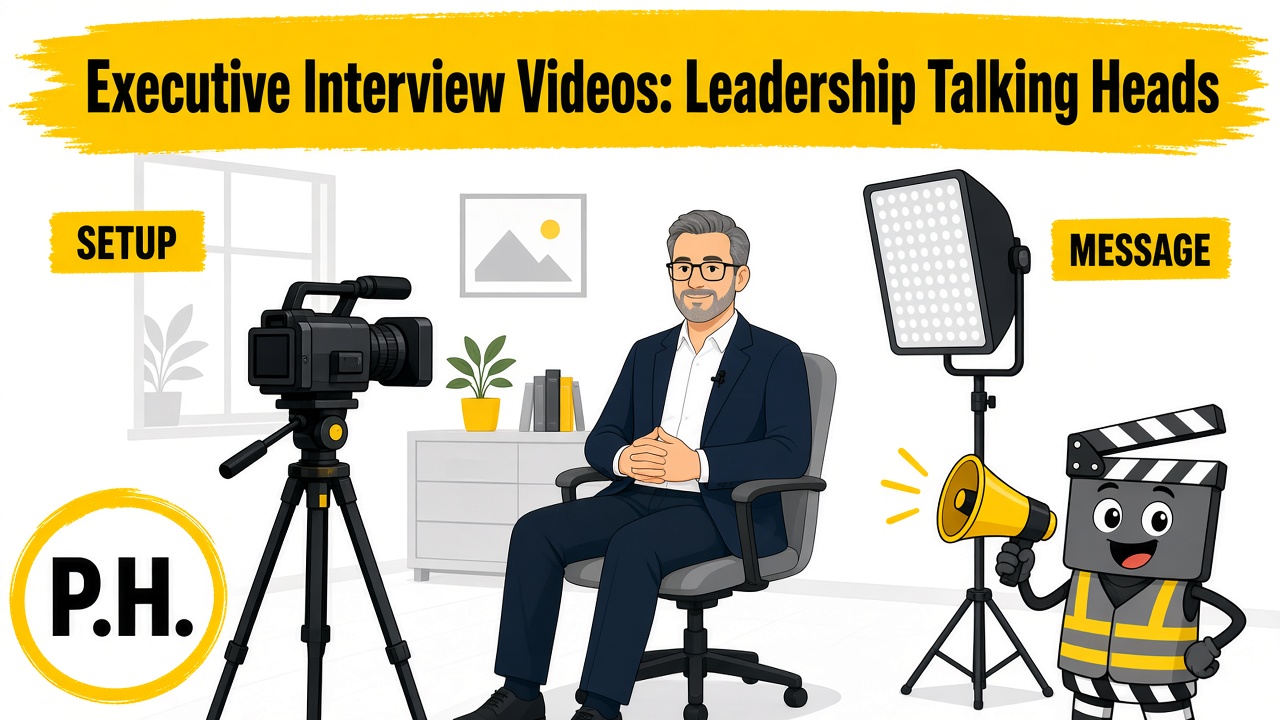
An executive interview video works when the leader sounds like themselves, the frame looks intentional, and the audio holds up on a laptop speaker. That comes from a clear brief, a calm setup, and a crew that knows how to work with non-actors.
This guide covers how to plan and produce leadership talking heads: what the job is, how it differs from other corporate formats, and what to lock before call time. For the wider corporate lane, see corporate video production: everything you need to know. When you write the ask, use how to write a video production brief.
Who this guide is for
This article is for marketing leads, internal communications, agency producers, and in-house teams who need a CEO interview video production day that does not waste executive time.
It is especially useful when you are:
- Cutting a leadership talking head video for the website, investor page, or all-hands follow-up
- Booking a corporate interview video with a subject-matter expert (SME) who is not a trained presenter
- Comparing a lean two-person team against a fuller package for one primary interview
- Hiring outside help and need a practical checklist before you browse listings
You do not need a studio build. You need a defined message, a controlled room, and a shoot plan the executive can follow.
Executive interview vs testimonial vs training
These three formats share a camera and a talking head. They do not share the same job.
Executive interview / leadership talking head. One leader (or a short series) speaks to strategy, culture, product direction, or an announcement. Audience is employees, customers, investors, or press. Tone is authoritative but human; pacing is tighter than a long sit-down.
Client or customer testimonial. The speaker is validating an outcome. Framing, questions, and edit rhythm favor proof and story. For that workflow, see testimonial videos: plan, shoot, and edit client stories.
Employee training. The speaker is teaching a process, policy, or skill. On-screen structure, chapters, and supporting B-roll matter more than brand polish. Use the training videos for employees production guide for HR teams when the deliverable is learning, not leadership messaging.
Mixing these jobs on one shoot creates muddy briefs. If the CEO clip must also train managers or double as a customer story, split the questions and plan separate edits.
Define the job
Write the job in one page before anyone books a room.
- Purpose. Announce, reassure, recruit, explain a change, or introduce a product line.
- Audience. Employees only, public web, press kit, or paid social.
- Length targets. Full master (often 2-4 minutes), short cutdowns (30-60 seconds), and optional vertical or square crops.
- Message pillars. Three points max. If you need six, you need two videos or a different format.
- On-camera talent. CEO only, executive panel, or SME interview shoot with a domain lead.
- Delivery. Master file specs, captions, stills for thumbnails, and who approves the cut.
Scope also decides hiring. Browse corporate video production and marketing videos when you want teams already oriented to this format, or compare full-service video production when you want one point of contact for prep, shoot, and edit.
Brief the executive
Leaders rarely fail because they “lack charisma.” They fail when they walk in cold, get open-ended questions, and try to invent structure on camera.
Send a short brief 48-72 hours ahead:
- Purpose and audience in two sentences
- The three message pillars in plain language
- Sample questions (not a teleprompter script unless they asked for one)
- Wardrobe notes: solid colors, no fine patterns, avoid logos that conflict with brand rules
- Timing: arrival, makeup or touch-up if any, interview block, buffer for pickups
- Who will be in the room (crew roles only; keep the audience small)
Offer a 10-minute phone sync the day before. Confirm pronunciation of product names, partners, and any numbers they can say. If legal must review claims, do that before the shoot, not in the edit.
On set, the interviewer sits just off camera, holds eye line, and asks one question at a time. Leave a beat after answers; do not rush to fill silence.
Location and look
Pick a room you can control for 90 minutes, not the flashiest glass conference room with uncontrolled windows.
Good defaults:
- Quiet HVAC or the ability to pause it during takes
- Soft, even daylight you can cut with blinds, or no daylight so lighting stays consistent
- A clean background: bookshelf, branded wall with restrained signage, or a shallow office depth with practical lamps
- Power within cable reach without crossing walkways
- Space for lights, C-stands, and a quiet holding area for the executive
Avoid open offices, kitchens, and rooms next to elevators. If the floor is busy, schedule early or late and post a “recording in progress” note on the door.
Match brand guidelines without turning the frame into a booth. One subtle logo is usually enough. Kill glasses reflections by softening the key and shifting the executive a few degrees.
Camera, lighting, audio for non-actors
Camera. A locked-off A-camera on sticks is enough for many leadership talking heads. Add a second camera when answers run long and you want coverage. Keep focal length flattering (often short-telephoto for seated interviews) and eye line just off lens toward the interviewer. Browse camera operators and videographers for operators who already work corporate interview days.
Corporate talking head lighting. Soft key, gentle fill, and a subtle separation light or practical in the background. Softboxes or diffused LEDs beat hard overhead cans. If the face looks shiny, lower intensity or add diffusion rather than cranking contrast. Keep the background a stop or two darker than the face.
Lav mic interview setup. Clean dialogue is non-negotiable. A lav on the lapel or center chest, routed to a recorder or camera with proper gain, is the baseline. Add a boom as backup when the budget allows. Hide the cable under the jacket, check rustle on head turns, and record 30 seconds of room tone. For dedicated mixers and kits, start with production sound mixers.
Watch for wireless interference, phones in pockets, and badge lanyards hitting the mic. Silence devices and remove noisy jewelry before roll.
Crew size that usually fits
Most single-executive interview days land in one of three shapes:
- Lean (2 people): camera/operator + sound (or a strong one-person band with lavs and a simple light kit). Works for short web clips when the room is already friendly.
- Standard (3-4 people): camera, sound, lighting support, and a producer or director who runs the brief and protects the executive’s time.
- Fuller package: dual camera, dedicated gaffer/grip support, makeup, and a producer managing stakeholders. Useful for multi-executive days or brand-critical launches.
Match crew to risk, not ego. A calm producer who keeps questions on rails often saves more time than an extra camera. When hiring a la carte, use how to hire film and video production pros to compare listings the same way every time. For a wider browse, open the ProductionHelp directory.
Shoot-day flow
A predictable day reduces nerves.
- Load-in and quiet check. Confirm power, noise, and background before the executive arrives.
- Light and frame. Lock marks for chair height, eye line, and standing mark if you also shoot a standing open.
- Audio check. Lav placement, levels, and a short scratch take with the stand-in or producer.
- Executive arrival. Wardrobe check, water, short reminder of the three pillars. No long speeches.
- Warm-up question. Something easy and true so the first real answer is not the first time they hear their voice in the room.
- Core questions. Work the pillars. Ask for shorter restatements when an answer rambles.
- Pickups. Specific lines, name pronunciations, or a clean open and close looking at lens if the edit needs it.
- Stills and safety. Grab a few frames for thumbnails if planned. Confirm no sensitive documents are visible on screens in the background.
- Wrap. Thank them, note expected review timing, and protect the buffer so the next meeting is not late.
Keep the room small. Extra stakeholders behind camera create performance pressure and side coaching. Route feedback through one producer.
Edit and versions
Edit for clarity first. Cut breaths and false starts without making the speaker sound unnatural. Keep lower-thirds accurate. Add captions for accessibility and sound-off viewing.
Plan versions before the cut:
- Master for the primary page or announcement
- 60- and 30-second cutdowns for email, ads, or social
- Vertical or square crops only if you framed with safe margins or have a second camera that supports them
- Audio-clean transcript for internal reuse and quote approval
Send one consolidated review round with time-coded notes when possible. Fold legal, brand, and executive comments into one pass so the editor is not chasing conflicting directions.
If the same footage must also support training or testimonials, duplicate sequences rather than forcing one cut to do every job.
Next step
If you need help producing an executive interview video, start in the ProductionHelp directory, then narrow to corporate video production and marketing videos, camera operators and videographers, production sound mixers, or full-service video production. Bring a one-page brief, length targets, and three message pillars. That is enough for a serious crew to quote and prep a leadership talking head day.