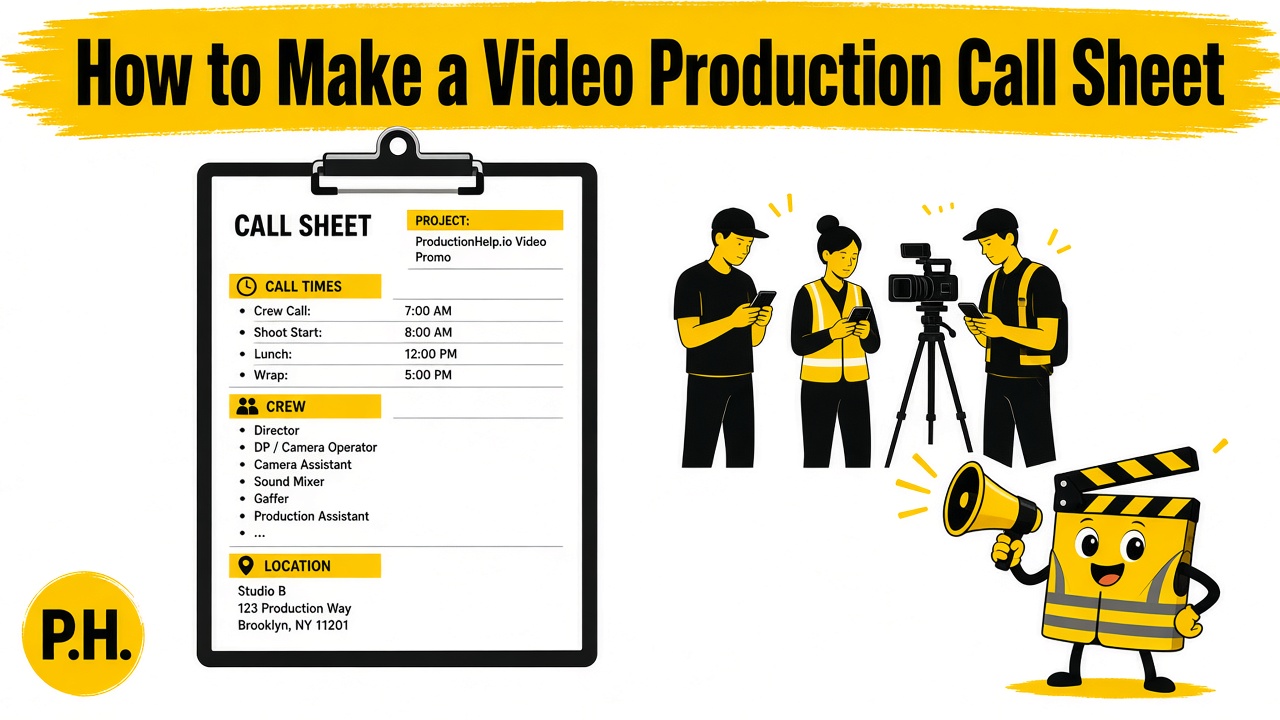
A video production call sheet is the one-page (or few-page) document that tells every person on a shoot where to go, when to arrive, who to call, and what the day looks like. When it is clear, crews show up ready. When it is vague, you spend the morning answering the same five texts.
This guide is for producers and marketing leads building a call sheet for corporate, branded, or interview days. It sits above the hour-by-hour plan in video shoot day timeline: call to wrap. Pre-production still comes first (the 7-step pre-production checklist every video shoot needs). Staffing decisions live in how to hire film and video production pros.
Who this is for
Use this if you are:
- An agency or in-house producer publishing the sheet the day before a corporate or branded shoot
- A marketing lead who needs one document clients, talent, and freelancers will actually open
- A coordinator turning a brief and location notes into call times, parking, and contacts
- Running a half-day interview, multi-setup office day, or light multi-location branded content day
You do not need a feature-film call sheet with every union field filled. You need accurate times, readable contacts, and logistics people can follow without calling you at 6:40 a.m. On larger days, a production coordinator often owns distribution and version control even if you draft the first pass.
What a call sheet is (vs timeline, brief, and budget)
A call sheet answers who, where, when, and how to find help. It is the distribution document for the day.
It is not:
- The shoot day timeline. The timeline is the sequence of work under the sheet (load-in, build, roll, meal, wrap). Pair this article with the video shoot day timeline so numbers match.
- The creative brief. Goals, audience, tone, and deliverables belong in the brief. Tighten those with how to write a video production brief before you invent call times.
- The budget. Rates, kit fees, and contingencies live in a budget worksheet (how to create a video production budget). Do not paste private rate columns onto a sheet that goes to every freelancer.
Think of the call sheet as the shared map. Brief and budget feed it. Timeline rides with it (or as an attached page). Location access details should already be checked with how to scout a video production location.
Must-have sections of a production call sheet
Keep the sheet scannable. Put the highest-stakes facts at the top. Crews skim on phones in parking lots.
1. Header
- Production or project name
- Date (day of week + calendar date)
- Producer / production company contact
- Version number and “as of” timestamp (example: v3, 2026-09-09 4:00 p.m. ET)
- Weather note if any exterior work is planned (high-level forecast only; update if it changes)
2. Date and location block
- Full street address, suite, and building name
- Nearest cross street or landmark if the entrance is easy to miss
- Load-in door vs talent entrance (often different in offices and campuses)
- Wi-Fi or hotspot plan if talent or producers need it for approvals
3. Call times (crew vs talent)
List general crew call, any early calls (lighting, sound, art), and talent call separately. Never bury talent time in a paragraph. Hard outs belong next to the name.
4. Crew and talent lists
For each person: role, name, call time, phone, and email if you use email for day-of changes. Group by department: camera, sound, lighting/grip, production, client, talent. Browse camera operators and videographers, gaffers, and production sound mixers when you are still staffing those lines.
5. Key contacts
- Producer on set (primary)
- Client stakeholder (one decision-maker)
- Location contact / facilities
- Nearest urgent care or ER address for the shoot ZIP (verify locally; do not invent hours)
- After-hours building security if relevant
6. Schedule blocks
A condensed schedule is enough on the call sheet: block name, start-end, short note. Point people to the full timeline page for detail. Example blocks: load-in, set build, tech, talent A, B-roll, meal, wrap.
7. Parking and load-in
- Where vans and cars park
- Validation or gate code process
- Freight elevator reservation window
- Floor protection or quiet-hours notes from facilities
8. Safety notes
Keep this qualitative and practical: trip hazards, stairs, wet load-in, allergy notes for craft if shared, and any site rules the location gave you. If permits or union rules apply on your job, note that those details must be verified for that city, venue, and agreement. Do not treat a blog list as legal advice.
9. Meal
- Meal start and expected duration
- On-set vs walkable options
- Whether talent eats with crew or separately
- Allergy contact (who collects dietary notes)
10. Weather and contingency
- Interior hold location if rain kills an exterior
- What gets cut first if the day runs late
- Who decides a weather call and by what clock time
Call times that do not break the day
Crews use call sheets that respect build time. Talent use call sheets that respect their calendar.
Give the crew a quiet build window. Camera, lighting, and sound should arrive before talent unless the day is a true walk-and-talk with no set build. Lighting-heavy rooms need earlier electric/grip calls. Dialogue-heavy days need sound early enough to place lavs without rushing.
Talent call is not crew call. Mic, wardrobe check, and a warm-up question need 10-20 minutes before rolling. If an executive has a hard out, put it in bold next to their name and reverse-engineer the interview length from that out, not from wishful thinking.
Stagger early calls only when needed. Calling everyone at 7:00 a.m. for a 10:00 a.m. talent block wastes money and patience. Call lighting and production early; call a second camera later if Setup B is afternoon-only.
Publish meal as a real block. A meal that exists only in the producer’s head will get overwritten by “one more setup.”
Match these times to the hour-by-hour plan in the shoot day timeline guide so the sheet and the board never disagree.
Simple half-day corporate example
Single location, one primary interview, supporting B-roll. Adjust earlier if blackout or a heavy lighting build is required.
| Field | Example |
|---|---|
| Project | Acme Q3 leadership interview |
| Date | Thu 2026-09-10 |
| Location | 100 Main St, Suite 400 (load-in: freight elev B) |
| Crew call | 8:00 a.m. |
| Talent call | 9:30 a.m. (hard out 11:00 a.m.) |
| Meal | 11:45 a.m. (wrap-adjacent / walking lunch OK) |
| Wrap target | 12:15 p.m. |
| Block | Clock | Note |
|---|---|---|
| Load-in | 8:00-8:30 | Park, freight, protect floors |
| Set build | 8:30-9:15 | Lights, camera, audio |
| Tech | 9:15-9:30 | Frame, levels, room tone |
| Talent / interview | 9:30-10:45 | Mic, brief, roll, pickups |
| B-roll | 10:45-11:45 | Priority cutaways only |
| Wrap / backup | 11:45-12:15 | Cards, releases, restore room |
Put names and phones on the real sheet. This table is the skeleton, not a finished distribution PDF.
Distribution and version control
Who gets it. Every working crew member, on-camera talent (or their handler), the client stakeholder, and the location contact if they need access times. Do not send private budget pages in the same PDF.
When to send. Afternoon before the shoot is the default for corporate days. Same-morning sheets are a last resort and create missed calls. If major logistics change after send, issue a new version immediately.
What changes require a new version. Call time shifts, location or load-in changes, talent hard-out changes, meal moves, and contact swaps. Cosmetic typos can wait; logistics cannot.
How to label versions. Use v1, v2, v3 in the filename and header, plus the “as of” time. In the email or message subject, write “CALL SHEET v3 – PROJECT – DATE” so older PDFs are obvious.
Confirm receipt. Ask key roles (camera lead, sound, client, talent) to reply “got it.” A sheet nobody opened is not a plan.
On bigger crews, the coordinator owns the send list. On lean days, the producer owns it. Either way, one person is accountable.
Common call sheet mistakes
These show up constantly on corporate and branded days. They overlap with common production mistakes that cost time and money.
- Talent listed at crew call. Build time disappears; everyone mic-checks in a half-built room.
- One contact blob. No primary producer phone, no location contact, no urgent care address.
- Parking omitted. Crew circles the block while the clock runs.
- Schedule that disagrees with the timeline. Sheet says meal at noon; timeline says 11:30. Pick one source of truth and sync both.
- No version number. Three PDFs named “final” circulate; someone follows the wrong one.
- Safety and site rules buried. Freight hours, quiet floors, and allergy notes belong on page one, not in a side chat.
- Sending the sheet with the budget. Rates do not belong on a widely shared call sheet.
- Assuming permits or union status. If your production requires local permits or works under a collective agreement, verify those requirements for that job. Do not copy informal “rules of thumb” as facts.
Next step
Draft the header, call times, contacts, parking, and condensed schedule first. Attach or link the full call-to-wrap timeline. Lock the creative inputs with a solid production brief and pre-production checklist before you publish times.
When you are ready to staff the sheet, use how to hire film and video production pros, browse the ProductionHelp directory, and shortlist camera operators and videographers, production sound mixers, gaffers, or full-service video production. Questions about listings: contact or about. A call sheet crews actually use is short, versioned, and honest about when people are needed.