
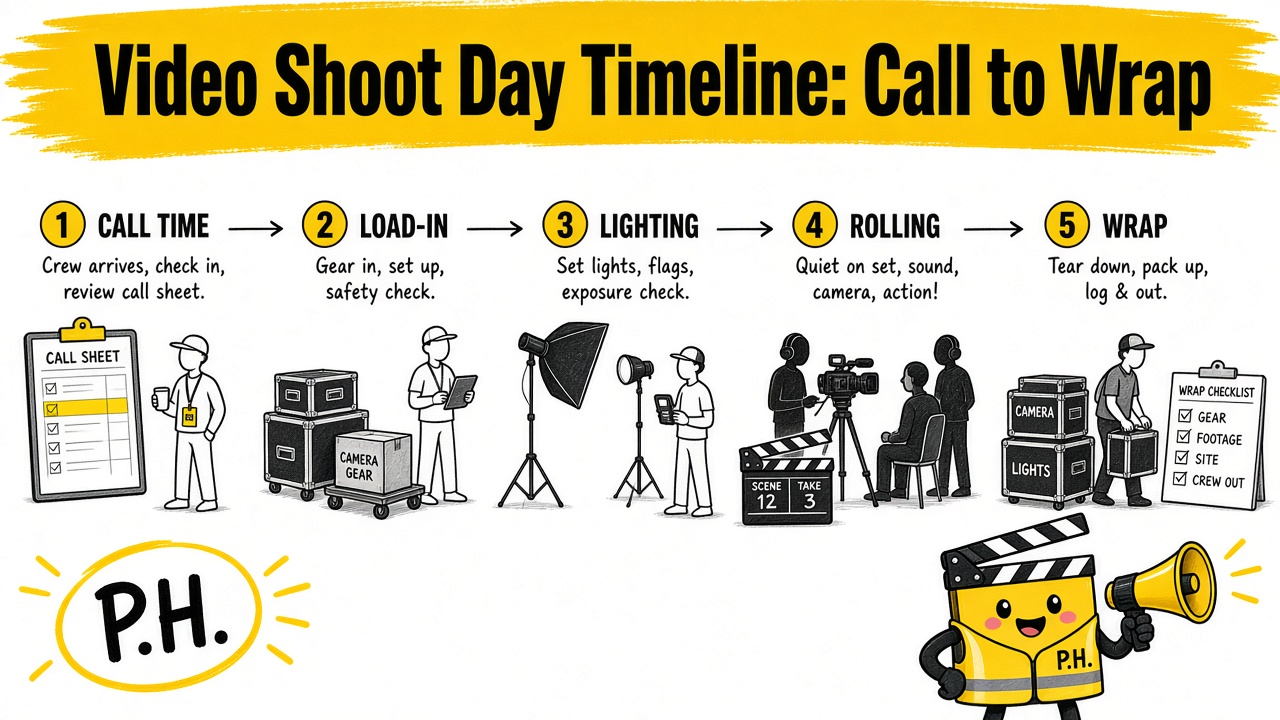
A video shoot day timeline keeps the crew, client, and talent on the same clock. Without one, load-in spills into the first interview, lunch lands in the middle of a lighting reset, and wrap turns into a scramble for cards and releases. With one, people know when they are needed, what “ready to roll” means, and how much buffer sits between company moves.
This guide is a practical call-to-wrap schedule for producers and marketing leads running corporate, branded, or interview-style days. It complements the 7-step pre-production checklist every video shoot needs (what to lock before the day) and pairs with how to hire film and video production pros when you are staffing the timeline. For a leadership talking-head day with its own room and brief constraints, see executive interview videos: leadership talking heads.
Who this guide is for
This article is for producers, agency producers, in-house marketing managers, and coordinators who need a shoot day schedule they can put on a call sheet and actually follow.
It is especially useful when you are:
- Running a half-day or full-day corporate video shoot with interviews, B-roll, and one or two locations
- Explaining call time, meal, and wrap to a client who has never been on a set
- Deciding whether you need a dedicated sound mixer, gaffer support, or a lean camera-and-sound team for the clock you have
- Building a production day timeline that protects overtime and still leaves room for pickups
You do not need a feature-film call sheet. You need clear blocks, named owners, and realistic buffers.
What a shoot day timeline is (and is not)
A video shoot day timeline is the hour-by-hour plan from crew call through wrap and media handoff. It sits under the call sheet: the sheet lists who, where, and when; the timeline explains the sequence of work.
It is not a creative treatment, a full budget, or a post schedule. Treatments and shot lists feed the timeline. Budgets belong in their own worksheet (see how to create a video production budget). Editing has a separate clock; this article stops at wrap and a clean handoff.
Treat the timeline as a living document. Weather, talent delays, and noisy neighbors will move blocks. The point is to know what you will cut when something slips, not to pretend the day will be perfect.
Lock these inputs the day before
A timeline fails when the inputs are vague. Before you publish call times, confirm:
- Deliverables and setups. How many interview looks, how much B-roll, how many rooms or exteriors.
- Talent windows. Exact arrival and hard out for every on-camera person.
- Location access. Load-in door, parking, freight elevator, quiet hours, and who holds keys. Location surprises are common; how to scout a video production location covers what to check before you trust a floor plan.
- Gear path. Kit owned by crew vs rentals; who picks up and who returns. Browse camera rentals and equipment and rental houses when the day depends on a package arriving on time.
- Crew roles and call order. Lighting-heavy days often need gaffer support early; dialogue-heavy days need sound early. Compare gaffers and production sound mixers when those departments are not optional.
- Meal and craft. Who orders, where people eat, and whether talent eats with crew or separately.
- Handoff. Who backs up cards, who holds releases, and where the drive goes overnight.
If the brief is still fuzzy, tighten it with how to write a video production brief before you lock call times.
Sample half-day timeline (corporate interview + B-roll)
Use this as a starting template for a single-location half day with one primary interview and supporting B-roll. Adjust call earlier if the lighting build is heavy or the room needs blackout.
| Block | Clock (example) | What happens | Owner |
|---|---|---|---|
| Crew call / load-in | 8:00-8:30 | Arrive, unload, protect floors, find power and quiet | Producer + camera lead |
| Set build | 8:30-9:15 | Lights, camera, audio, background tidy | Camera, lighting, sound |
| Tech rehearsal | 9:15-9:30 | Frame, levels, stand-in, room tone | Full crew |
| Talent arrival / brief | 9:30-9:45 | Wardrobe check, mic, warm-up question | Producer |
| Interview rolling | 9:45-10:45 | Core questions, short restatements, pickups | Director/producer + crew |
| Reset / B-roll | 10:45-11:45 | Product, workspace, cutaways | Camera (+ sound if needed) |
| Wrap / backup | 11:45-12:15 | Strike, card backup, releases, location restore | Producer + camera |
Do not schedule talent at crew call. Give the crew a quiet build window. If the interview is the whole job, cut B-roll rather than compressing the interview into noise and nerves. For lav placement and dialogue priorities, see the lavalier microphone guide for video production.
Sample full-day timeline (two setups or light multi-location)
A full day usually needs a real meal break and a protected company-move block. Example for office interview in the morning and campus or product B-roll in the afternoon:
| Block | Clock (example) | What happens |
|---|---|---|
| Crew call / load-in | 7:30-8:15 | Load-in, park, stage cases |
| Setup A build | 8:15-9:15 | Primary interview look |
| Talent A | 9:15-10:30 | Interview block with buffer |
| Pickup / stills | 10:30-10:45 | Clean opens, thumbnails if planned |
| Partial strike / move | 10:45-11:30 | Soft strike; leave what you reuse |
| Meal | 11:30-12:15 | Full crew meal; protect uninterrupted time |
| Setup B / exterior | 12:15-1:00 | Second look or exterior walk-and-talk |
| B-roll rolling | 1:00-3:00 | Coverage list with priority order |
| Contingency | 3:00-3:30 | Weather, noisy HVAC, late talent, one reshoot |
| Wrap / handoff | 3:30-4:15 | Backup, inventory, restore location, release talent |
Build contingency into the published timeline. If you only put it in your head, the client will fill that hour with “just one more thing.”
Minute-by-minute owners during rolling blocks
During rolling time, the timeline should answer three questions for every person on set: Am I needed? Where do I stand? Who do I ask?
Producer or coordinator. Protects the clock, runs talent, holds releases, decides what gets cut when you are late. A strong production coordinator mindset helps even on small days: one person owns the board.
Camera. Owns frame, focus, card discipline, and whether the shot list is actually covered. Browse camera operators and videographers when you need an operator who can move fast between interview and B-roll.
Sound. Owns lav placement, boom, and the call to cut when a plane, HVAC, or hallway kills a take. Dedicated mixers matter when dialogue is the deliverable.
Lighting / gaffer. Owns safe power, consistent key, and how long a look change really takes. A “quick window move” is rarely five minutes; put real time on the sheet.
Client stakeholder. One feedback channel. Extra executives behind camera burn timeline faster than almost any gear issue.
When you are unsure whether to hire a la carte or one package, camera crew vs full-service production company helps you match structure to the day you planned.
Timeline killers (and how to schedule around them)
These patterns show up on corporate and branded days. Plan for them explicitly.
Late talent with an early hard out. Book talent arrival after build, and put the hard out on the call sheet in bold. If the window is 45 minutes, do not plan a 40-minute interview plus wardrobe plus mic.
“Quick” location changes. Elevators, security desks, and street crossings add time. Pad company moves; never stack two moves back to back without buffer.
Lunch as an afterthought. A skipped or late meal creates overtime and short tempers. Put meal on the published timeline and protect it.
Unowned media backup. End-of-day card chaos is a timeline and a data risk. Assign backup before call: who copies, to what drives, and who confirms a second copy before format.
Scope creep during B-roll. Keep a prioritized shot list. When the clock slips, shoot priority one and two, not the nice-to-have hallway montage.
Many of these overlap with common production mistakes that cost time and money. The timeline is where you prevent them on the day, not only in a postmortem.
Call sheet fields that make the timeline usable
Your call sheet and timeline should share the same numbers. Minimum fields:
- Date, production name, weather note if exterior
- Location address, load-in instructions, parking, wifi or hotspot plan
- Crew call vs talent call (never identical unless it is a walk-and-talk with no build)
- Meal time and nearest food if off-site
- Emergency contacts and nearest urgent care for the shoot address
- Setup order matching the timeline blocks
- Wrap target and who stays for strike
Send the sheet the afternoon before. Confirm receipt from every key role. A timeline nobody opened is decoration.
Match crew size to the clock
A tight half-day with one interview can run lean if the room is friendly and audio is simple. A full day with look changes, exterior work, and executive talent usually needs more hands so the producer is not also holding a boom and chasing lunch orders.
Practical matching:
- Lean: Camera + sound (or strong dual-threat operator) when setups are few and the room is already quiet
- Standard: Camera, sound, lighting support, producer
- Fuller: Dual camera, dedicated electric/grip support, coordinator, and clear client liaison
Browse the ProductionHelp directory to shortlist by role, or compare full-service video production when you want one point of contact. For corporate-oriented teams, start with corporate video production and marketing videos. Equipment planning for office days pairs with the video production equipment checklist for corporate shoots.
Wrap is part of the timeline
Wrap is not “everyone leaves.” Build 30-60 minutes for:
- Confirm cards are copied and labeled
- Collect talent releases and location notes
- Photo of the room restored (helps with deposit disputes)
- Gear inventory against the morning list
- Next-day post note: who has the drive, proxy expectations, and first cut target
If the client asks for a same-day select, put that in the morning plan. Do not invent a select session at 4:50 when the location must be clear at 5:00.
Next step
Start with the half-day or full-day template above, plug in real talent windows and location access, then staff the blocks. When you are ready to hire, use how to hire film and video production pros, browse the directory, and narrow to camera operators and videographers, production sound mixers, gaffers, or full-service video production. Questions about listings or getting listed: contact or about. A clear video shoot day timeline is one of the simplest ways to protect quality without adding budget theater.